Rowena Drake's Broken-Vase Wet-Clothes Alibi
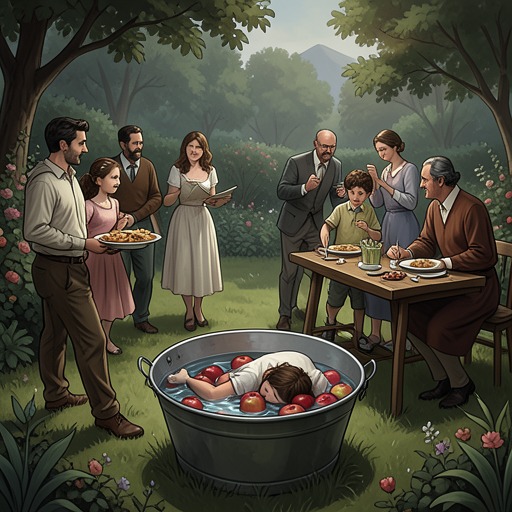
Hallowe'en PartyRowena Drake's Broken-Vase Wet-Clothes Alibi is the staged accident by which Rowena Drake concealed her role in Joyce Reynolds’s murder. After drowning Joyce in a bucket during the Hallowe'en party, Drake needed an explanation for being wet; she supplied one by deliberately smashing a water-filled vase while Elizabeth Whittaker was present. What looked like an awkward mishap became a rehearsed cover story, and Whittaker’s account helped Hercule Poirot identify its purpose.
The problem of the water
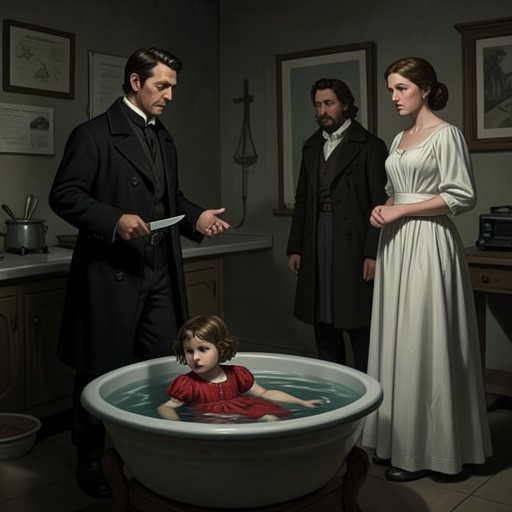
The ruse begins with the physical consequence of the killing. Poirot asks whether there was a good deal of water at the scene. Drake confirms that there was water in the bucket and observes that if a child’s head had been pushed under it, water would have splashed onto the sheet. Her explanation identifies the practical difficulty facing the murderer: holding down a vigorous child would involve struggling and splashing, so Joyce’s killer would almost certainly become wet. The murderer’s wetness was not incidental; it was a trace that needed an innocent explanation.
Poirot later makes that logic explicit. He looks for someone who had been at the party and was wet despite having no ordinary reason to be. Drake had killed Joyce and, as a result, was soaked. During the Snapdragon, when the guests crowded into the dining-room, she took Joyce with her to the library. Joyce had no reason to suspect her. Miranda Butler had told Joyce only that she had once seen a murder committed; Joyce herself had never witnessed a murder. Drake’s need to explain her wet clothes arose from the physical act of the killing, while her suspicion that someone might have witnessed an earlier crime supplied a separate fear in the background.
The vase as a staged explanation
Drake arranged for her wetness to acquire a visible, apparently accidental cause. She waited on the first-floor landing with a large vase of flowers and water. The Snapdragon room had grown hot, and Whittaker came out into the hall. From there, Whittaker saw Drake pause at the angle of the staircase, holding the heavy vase awkwardly. Drake appeared to adjust it so she could support it with one arm and reach for the stair rail with the other. She looked past the vase and toward the hall below, in the direction of the library door.
Whittaker’s account emphasizes the suddenness of what followed: Drake started as though something had startled her, released the vase, and let it fall to the hall floor. It turned over on the way down, sending water over Drake before it shattered. In Poirot’s reconstruction, the start was an act. Drake deliberately made the vase fall and ensured that its water drenched her, transforming evidence of the murder into the apparent result of an accident. The broken glass and scattered flowers made the incident conspicuous; Whittaker’s presence made it useful as an alibi.
Whittaker’s testimony and Drake’s account
The vase incident mattered because it left a witness. Whittaker helped Drake pick up the pieces and sweep the glass out of the way, and the two left it in a corner by the grandfather clock to be cleared later. Poirot concludes that Drake also led Whittaker to think she had seen someone, or something, coming out of the room where a murder had been committed. Whittaker accepted that impression at face value. When she later mentioned the incident to Miss Emlyn, however, Miss Emlyn recognized its significance and urged her to tell Poirot. A detail that initially seemed to point toward a possible witness to murder instead became evidence about the person who had arranged the scene.
When Poirot raises the broken vase with Drake, she supplies an ordinary explanation for having carried it. She says that she noticed the autumn leaves and chrysanthemums drooping in a glass vase on the stair landing, discovered that it contained no water, and took it into the bathroom to fill it. She describes the vase as a wedding present, valuable to her because it was a handsome, sturdy vessel suited to large autumn bouquets. She then acknowledges that it fell and broke, attributing the fall to her fingers slipping. Her account makes the handling of the vase seem accidental and explains why it would have contained water; Whittaker’s description, especially Drake’s pause and apparent start, gives Poirot the means to read the same episode differently.
Reconstruction and consequence
The explanation depends on connecting separate observations rather than treating the broken vase as an isolated mishap. The bucket and wet sheet establish why Joyce’s killer would be wet; Whittaker’s detailed memory establishes that Drake was drenched when the vase broke; and the staged appearance of surprise explains how a deliberate act could pass as an accident. Poirot’s solution makes the vase’s water serve two purposes at once: it explains the murderer’s wet clothes in public and lends credibility to the visible story that Drake had simply suffered an unfortunate spill.
The deception also turns on a mistaken assumption. Drake had long suspected that someone was present in Quarry Wood when she and Michael Garfield killed Olga Seminoff, and she feared that this person might have seen them. Joyce’s claim to have seen a murder seemed to Drake to confirm that danger. But Joyce had seen no murder. Poirot’s explanation therefore separates the earlier crime Drake feared might have been witnessed from the later murder she committed to silence Joyce. Once Whittaker’s account is understood as a manufactured alibi rather than a report of a startling accident, Poirot says he knows who killed Joyce. The vase does not merely hide the wetness: its staged fall exposes the calculation behind it.